Sally,
How much water do you collect when it rains and how much water do you use every day?
GeorgeW and Charlie C
Tuesday, 2 December 2008

Tuesday, 4 November 2008
Aride Corner at Grand Anse is nearly complete
When I returned off leave from the UK, I found that the children of Grand Anse School had been working very hard and they had nearly completed the Aride Corner. All the painting was finished, from the fish to the frigate birds. The end wall included painted pictures of fairy terns, turtles, sooty terns and turnstones together with the impressive frigate birds. 


 There are just the last few finishing touches to do, and one is the painting of a Wright’s Gardinier on the side wall above the area that they are going to keep as a notice board for environmental issues. The Wright’s Gardinier is a very special plant and Aride is the only place in the whole world where it can be found growing naturally and the EcoAride club felt that the corner wouldn’t be complete without one.

Before


To cover the floor the children have brought in sand and that has provided the foundation for some of the vegetation we find on Aride, such as coconut palms and Scaevola; a beach crest plant which has fleshy leaves and is salt tolerant.
All that was left to do was the creation of a few 3 dimensional papier mâché models to compliment the painting. The children had already made a start, and so far these include a Wright’s skink (type of lizard), and a turtle to sit on the sand, together with a bird which is going to soar through the air below the’ Welcome to Aride’ greeting.
There are just the last few finishing touches to do, and one is the painting of a Wright’s Gardinier on the side wall above the area that they are going to keep as a notice board for environmental issues. The Wright’s Gardinier is a very special plant and Aride is the only place in the whole world where it can be found growing naturally and the EcoAride club felt that the corner wouldn’t be complete without one. 

Before
After
The corner looks great and the other children in the school really like it, it brightens up what was originally a very dark stair well into something that is now not only very creative, but informative and educational too.
Tuesday, 21 October 2008
The Southeast monsoon – how Aride got its name.
We are now at the end of the southeast monsoon which falls between the end of May to the beginning of October. This monsoon brings very strong winds from the south east and is very dry, with hardly any rain over the 5 months. This type of weather makes living on an island a real challenge for many reasons and as a result we look forward to the arrival of the northwest monsoon again so life becomes a little easier.

The island changes in the southeast monsoon as the vegetation starts to struggle from a lack of water, the trees go brown and their leaves start to fall, it reminded me of autumn back in the UK, but it was still 30’C! Eventually only the bare branches of the trees are left and looking at the island from the sea it looks sad and dry, scorched by both the sun and the salt spray.

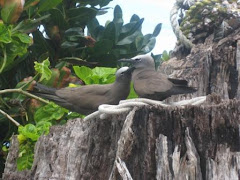
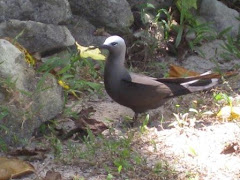
However Aride comes alive at this time of year with wildlife, it is the main breeding time for the seabirds that nest on the island. We have the world’s largest colony of lesser noddys and over 100,000 pairs of sooty terns, not to mention the brown noddys, fairy terns and bridled terns. So Aride becomes both a very busy, noisy and smelly place between May to October.

With the strong winds and the rough sea there is a lot of salt spray that gets blown on to the island, this puts a greasy, salty film over everything, from the vegetables in the garden, which we have to protect, to our clothes. The spray is driven by the wind into the houses and the office and can be very damaging, by causing everything to rust and go mouldy.
 It is often the case that because the sea is rough we rarely get visitors to the island and so it can feel quiet remote, even though we can see Praslin the island 6 miles away, we know the sea is to difficult to cross. Our work at this time of year is spent undertaking survey and monitoring work, mainly of the seabird colony, counting 1.25 million seabirds is quiet a difficult task and protecting them from poachers. We also spend time designing new displays and preparing the island for visitors, who will start to come once more in October.

The island changes in the southeast monsoon as the vegetation starts to struggle from a lack of water, the trees go brown and their leaves start to fall, it reminded me of autumn back in the UK, but it was still 30’C! Eventually only the bare branches of the trees are left and looking at the island from the sea it looks sad and dry, scorched by both the sun and the salt spray.

However Aride comes alive at this time of year with wildlife, it is the main breeding time for the seabirds that nest on the island. We have the world’s largest colony of lesser noddys and over 100,000 pairs of sooty terns, not to mention the brown noddys, fairy terns and bridled terns. So Aride becomes both a very busy, noisy and smelly place between May to October.
With the strong winds it means that the large expanse of sea becomes very rough and it is difficult to both launch and land the boat off and on to the island. With no jetty we have to launch the boat by hand, holding it still in the waves until the engine is deep enoug h in the water to run. It is a difficult task when there are waves taller than you trying to knock you off your feet, but it is the only way we can leave to go shopping and get supplies. Some years the sea is so rough at this time of year we don’t manage to leave the island for two weeks or more and so we have to make our food last. At this time the vegetables we grow in the garden are very important as a fresh food supply.
 h in the water to run. It is a difficult task when there are waves taller than you trying to knock you off your feet, but it is the only way we can leave to go shopping and get supplies. Some years the sea is so rough at this time of year we don’t manage to leave the island for two weeks or more and so we have to make our food last. At this time the vegetables we grow in the garden are very important as a fresh food supply.
With the strong winds and the rough sea there is a lot of salt spray that gets blown on to the island, this puts a greasy, salty film over everything, from the vegetables in the garden, which we have to protect, to our clothes. The spray is driven by the wind into the houses and the office and can be very damaging, by causing everything to rust and go mouldy.
The southeast monsoon can be a very difficult time to live on the island, the wind and salt spray are constant and we know that we will not be able to go over to the mainland very frequently. That is when the telephone and electronic communication become very important as we are unable to receive letters via the post office.
 It is often the case that because the sea is rough we rarely get visitors to the island and so it can feel quiet remote, even though we can see Praslin the island 6 miles away, we know the sea is to difficult to cross. Our work at this time of year is spent undertaking survey and monitoring work, mainly of the seabird colony, counting 1.25 million seabirds is quiet a difficult task and protecting them from poachers. We also spend time designing new displays and preparing the island for visitors, who will start to come once more in October.
However having said all this, the most significant thing for everyone living on the island in the southeast monsoon i s whether we have collected enough water to see us through this dry season. For 5 months we will not have any rain and so we will not have any new drinking water and we rely on the water that we have collected through the rainy season of the northwest monsoon. If we do have rain we are often unable to harvest it because the roof is too dirty from all the seabirds that roost there and it would be unsuitable to drink. This year we have been struggling for drinking water and we now have to boil the water and pass it through two filters, before we can drink it. This is quite a time consuming job as working in 32°C means we have to drink regularly to prevent us from becoming too dehydrated. Think now we are finding out how Aride got its’ name!
 s whether we have collected enough water to see us through this dry season. For 5 months we will not have any rain and so we will not have any new drinking water and we rely on the water that we have collected through the rainy season of the northwest monsoon. If we do have rain we are often unable to harvest it because the roof is too dirty from all the seabirds that roost there and it would be unsuitable to drink. This year we have been struggling for drinking water and we now have to boil the water and pass it through two filters, before we can drink it. This is quite a time consuming job as working in 32°C means we have to drink regularly to prevent us from becoming too dehydrated. Think now we are finding out how Aride got its’ name!
Wednesday, 23 July 2008
Hi,
It was great to catch up with the blog. We have just started our summer holiday but we are looking forward to getting on-line when we get back.
Class 4 will be doing a project on 'Water'. It was interesting to read about water on the island. We would like to know all about how the children in the two schools get their water, what they use it for, how much they use, if they have any problems related to water.
We look forward to learning lots from them.
Nina Bernstein
It was great to catch up with the blog. We have just started our summer holiday but we are looking forward to getting on-line when we get back.
Class 4 will be doing a project on 'Water'. It was interesting to read about water on the island. We would like to know all about how the children in the two schools get their water, what they use it for, how much they use, if they have any problems related to water.
We look forward to learning lots from them.
Nina Bernstein
Saturday, 19 July 2008
The Seasons of Seychelles
Here in the Seychelles the changing of the seasons is very different to back in the UK and life on Aride island changes with them. There are basically two seasons here and these are in the form of monsoons: the northwest and southeast and they are both dramatically different and hugely influence the way we live.
 This water is very important as it fills up the marsh and the well, which both the wildlife and us rely on in the drier months. The northwest monsoon is also the time when we harvest the rainwater for drinking. We do this by collecting all the water that falls on the roof of our house and put it in large barrels that we can then filter and drink. To make sure that the water is as clean as possible, it is very important to ensure that the roof is regularly washed off and that all the bird pooh, leaves and pine needles have been removed.

 The calmer seas mean that we are also able to do more work with the local communities at this time of year, as we can almost guarantee that the weather will enable us to make the 6 mile crossing to Praslin our neighbouring island. This means that we can reliably plan to work with the local schools and the tourist operators. Working on an island, reliant on the weather conditions, often means that it is very difficult to plan, which can result in us letting people down and not able to make appointments.
The more settled weather also means it is easier to be self sufficient for food; we are able to regularly catch our own fish as the sea conditions allow us to take the boat out for fishing. The vegetables and trees provide fruit more regularly due to the higher rain fall and crossings to the shops for supplies can be more frequent if we need them. As well as the tourists we have other important visitors during the northwest monsoon, which rely on the calmer seas and the sandy beach. These are the population of hawksbill turtles that come to lay their eggs on Aride. Hawksbill turtles are very special and we are very lucky to have them breeding here on the island, last year we had 63 nests, with some of the females laying over 3 nests each. They are very rare and still on the critically endangered list and were really threatened just a few years ago as people used to kill them to eat. Now they are protected and populations like Aride are very important for the recovery of the worlds’ population.

The Northwest Monsoon
When we first came to the island in December we arrived in the middle of the northwest monsoon, which is basically from October to April. This monsoon is stereotypically tropical and has high rainfall and high temperatures which the combination of the two bring with it high humidity. The high rainfall is a very important part of this time of year; it provides water for both the island and its occupants. The vegetation turns green and starts to look very lush and the ground water builds up as the water collects from the rain that falls on the hill and rushes down to the lower ground below.
When we first came to the island in December we arrived in the middle of the northwest monsoon, which is basically from October to April. This monsoon is stereotypically tropical and has high rainfall and high temperatures which the combination of the two bring with it high humidity. The high rainfall is a very important part of this time of year; it provides water for both the island and its occupants. The vegetation turns green and starts to look very lush and the ground water builds up as the water collects from the rain that falls on the hill and rushes down to the lower ground below.
This water is very important as it fills up the marsh and the well, which both the wildlife and us rely on in the drier months. The northwest monsoon is also the time when we harvest the rainwater for drinking. We do this by collecting all the water that falls on the roof of our house and put it in large barrels that we can then filter and drink. To make sure that the water is as clean as possible, it is very important to ensure that the roof is regularly washed off and that all the bird pooh, leaves and pine needles have been removed.The northwest monsoon is our busy time for visitors, the weather is a lot calmer and so the sea is calmer too, which means that it is easy for boats to reach us and for us to greet the visitors on them. The sea is also excellent for snorkelling at this time of year, which attracts many holiday makers, who come to see the tropical fish that live around the coral reefs of Aride. The weather at this time of year is largely settled and the temperatures can regularly reach over 30’C in the day and not drop to less than 28’C at night.
A large percentage of our work at this time of year is taken up with running the business of the island and increasing the money that can be raised from the tourism trade as this is the main source of income we have. We charge an entrance fee for visitors to the island and we have a small shop and information centre where we sell souvenirs and books. All the money that we can raise will then go directly back to supporting the conservation work undertaken for the wildlife of Aride.
The calmer seas mean that we are also able to do more work with the local communities at this time of year, as we can almost guarantee that the weather will enable us to make the 6 mile crossing to Praslin our neighbouring island. This means that we can reliably plan to work with the local schools and the tourist operators. Working on an island, reliant on the weather conditions, often means that it is very difficult to plan, which can result in us letting people down and not able to make appointments.The more settled weather also means it is easier to be self sufficient for food; we are able to regularly catch our own fish as the sea conditions allow us to take the boat out for fishing. The vegetables and trees provide fruit more regularly due to the higher rain fall and crossings to the shops for supplies can be more frequent if we need them.
As well as the tourists we have other important visitors during the northwest monsoon, which rely on the calmer seas and the sandy beach. These are the population of hawksbill turtles that come to lay their eggs on Aride. Hawksbill turtles are very special and we are very lucky to have them breeding here on the island, last year we had 63 nests, with some of the females laying over 3 nests each. They are very rare and still on the critically endangered list and were really threatened just a few years ago as people used to kill them to eat. Now they are protected and populations like Aride are very important for the recovery of the worlds’ population.Sunday, 15 June 2008
Baie Ste Anne EcoAride Club reuse and recycle to keep their school grounds clean
The children in the EcoAride Club at Baie Ste Anne have found an excellent use for old fuel drums. They are reusing and recycling the drums as rubbish bins, which will be placed around the school grounds to discourage other children at the school from dropping litter.
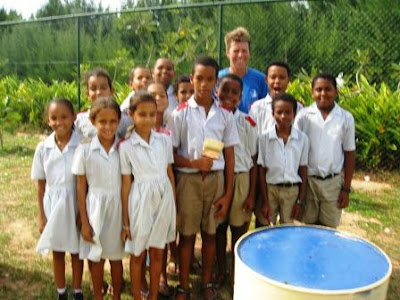
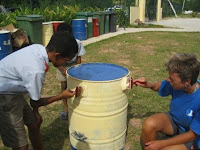
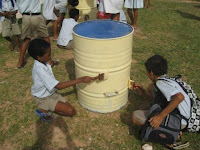
They also have plans to use the bins to enable people to separate their rubbish, by labelling each one as to which rubbish it is specifically for. This will then enable the school to separate out plastic, paper, non recyclables, cans and glass, so in the future the materials may be recycled.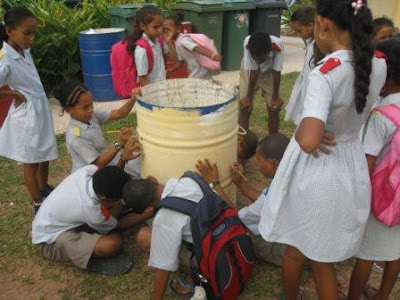

In their last two extra curricular activity sessions they have been working hard to transform their new litter bins into something that will look good at their school. First of all they have covered the bins with a coat of plain paint and now they have the task of designing brightly coloured images to make them look good and to encourage people to use them.

They also have plans to use the bins to enable people to separate their rubbish, by labelling each one as to which rubbish it is specifically for. This will then enable the school to separate out plastic, paper, non recyclables, cans and glass, so in the future the materials may be recycled.
Monday, 9 June 2008
Aride Island corner at Grand Anse Primary School
When I went into school this week the children of the EcoAride club in Grand Anse Primary School, had started to create their very own Aride Corner in the school. With the help of me and the teachers from the school, the children started to transform what was once a dark and dingy stair well into a colourful representation of Aride Island. Following a visit to the island made by many of the children earlier in the year, they were inspired to try and create their own miniature Aride that they could see everyday. The children have already written accounts of their visit, and now they were to use their artistic skills to visually depict what they have seen on the island. 
Initially the location of the corner presented a small challenge; however it has now been used to great effect, with the dark section under the stairs perfect for the colourful underwater scene, showing marine life, including tropical fish and turtles. The underneath of the stairs leading to the first floor makes and excellent place for a ‘Welcome to Aride’, together with large images of a frigate bird and of course the special red tailed tropic bird.
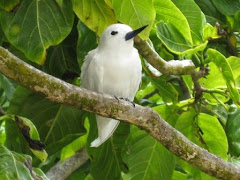
After just one Extra Curricular Activity session the corner is really starting to take shape and in coming weeks we hope to be working on cliff and woodland scenes, showing wildlife such as fairy terns, white tailed tropic birds, skinks and geckos. It is an excellent way to show other children from the school, just what Aride is like and hopefully get them interested too.
Initially the location of the corner presented a small challenge; however it has now been used to great effect, with the dark section under the stairs perfect for the colourful underwater scene, showing marine life, including tropical fish and turtles. The underneath of the stairs leading to the first floor makes and excellent place for a ‘Welcome to Aride’, together with large images of a frigate bird and of course the special red tailed tropic bird.
After just one Extra Curricular Activity session the corner is really starting to take shape and in coming weeks we hope to be working on cliff and woodland scenes, showing
 wildlife such as fairy terns, white tailed tropic birds, skinks and geckos. It is an excellent way to show other children from the school, just what Aride is like and hopefully get them interested too.
 Once we have finished the walls we hope that we can start to create some models on the floor, using recycled materials and papier mache. Th ere is so much wildlife that lives on Aride to choose from, the children will have to decide which represents the island the best and what are their favourites.
 ere is so much wildlife that lives on Aride to choose from, the children will have to decide which represents the island the best and what are their favourites.
This is just the start of the work that the EcoAride club are planning to do around the school to illustrate and communicate conservation messages and also to make the school grounds, colourful, interesting and a great place to learn
Subscribe to:
Posts (Atom)