BY CAYLEM D.H
Wednesday, 5 March 2008

What fish do you catch?
Hi Melv
What fish do you normaly catch and what fruit do you normaly get? How much water do you get each day?
From
Tom&Kieran
pinapples,geckos and pithons
Hi Sally,
I wanted to know why the pineapples are an orangy red in the Seychelles and are there geckos near where you live and pithons.
yours sincerely,
Luke.T & Charlie.O
How do you get your coconuts ?
To Sally,
I was just wondering how do you get your coconuts ?
I saw this video where the locals climb the tree and shake
down the nuts.Can Melv do this? It would be funny to watch him
try or succeed. I hate coconuts but Ben likes them.
From James proud & Ben Isaacs
I was just wondering how do you get your coconuts ?
I saw this video where the locals climb the tree and shake
down the nuts.Can Melv do this? It would be funny to watch him
try or succeed. I hate coconuts but Ben likes them.
From James proud & Ben Isaacs
Hello Sally
My name is Jade and I have got some questions to ask you.
Why you have got nets above your bed?
What else do you have for entertainment except from crabs and geckos to stare at?
Also, my friend Maureen would like to ask what kind of plants do you see over in the Seychelles.
I would like to hear your answers to these questions.
From Jade and Maureen
Year 5 and 6
My name is Jade and I have got some questions to ask you.
Why you have got nets above your bed?
What else do you have for entertainment except from crabs and geckos to stare at?
Also, my friend Maureen would like to ask what kind of plants do you see over in the Seychelles.
I would like to hear your answers to these questions.
From Jade and Maureen
Year 5 and 6
Thursday, 28 February 2008
Tropical Fruits
Well Classes 1 and 2, back in the early 1900’s as well as coconuts, different fruits were planted too and although most of those have now been removed there are still a few l eft in the garden, which we can harvest for ourselves and which form an important part of our diet.
So what are they?
We have bananas, oranges, grapefruits and limes, which are all very similar to what you can buy back in Britain.
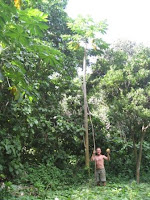
But our favourite must be the papaya, which grows on very tall trees in bunches, a little like coconuts. They are a soft fruit about the size of a small melon and a challenge to pick – it always takes two of us – one with a very long stick to dislodge the fruit, the other standing at the bottom of the tree ready to catch. We eat them like melons, but they have a texture of very ripe avocados, they are delicious.
So we are all really glad they didn’t remove all the fruit trees when they turned Aride into a nature reserve!
 eft in the garden, which we can harvest for ourselves and which form an important part of our diet.
So what are they?
Well we have pineapples - did you know they grow on a small, bushy, creeping plant on the ground? – We didn’t until we saw them here. The climate is so warm on the island pineapples grow throughout the year and ripen almost i nstantly – they taste fantastic.
 nstantly – they taste fantastic.
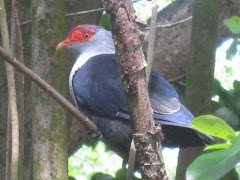
 There are guavas, which grow on trees and look a bit like small oranges. These are particularly good to eat and have a similar taste to sweet gooseberries. They are a real favourite for some of the birds here, particularly the blue pigeon and fruit bats.
We have bananas, oranges, grapefruits and limes, which are all very similar to what you can buy back in Britain.

But our favourite must be the papaya, which grows on very tall trees in bunches, a little like coconuts. They are a soft fruit about the size of a small melon and a challenge to pick – it always takes two of us – one with a very long stick to dislodge the fruit, the other standing at the bottom of the tree ready to catch. We eat them like melons, but they have a texture of very ripe avocados, they are delicious.
So we are all really glad they didn’t remove all the fruit trees when they turned Aride into a nature reserve!
Saturday, 16 February 2008
The Coconut Story
Well Class 4, originally only visited by travellers, Arab traders and pirates, in 1861 Aride had a very small permanent human population of two. From this time on the number of inhabitants increased and the island was developed as a plantation, with the coconut being the most useful tree. The flat plateau and large sections of the hill were soon cultivated commercially with all the native woodland lost by 1868. All the original big trees were felled for timber and much of the island was cleared. Originally the coconuts were limited to the beach crest, where they would have established from nuts that had been washed on to the beach. In the 1920’s and ‘30’s there was an extensive planting programme and they began to cover a large percentage of the island.
But why coconuts, well the nuts were gathered and the dried flesh called copra was extracted for oils. The Copra house where this was done can still be seen on Aride today and
 this we plan to preserve to tell visitors about the history of the island. However whether due to the remoteness, the harsh dry conditions or difficult seas around the island we will never know, but Aride fortunately never became a full copra plantation unlike many of the other outlying islands. In 1967 it had a stroke of good fortune and a visit from Paul Chernard, a local Seychellois, decided it was too special and should be preserved as a nature reserve. From this time the removal of the coconuts began and the natural forest was allowed to regenerate and this has continued to present day.
The coconut palms are now just restricted to the beach crest where they would have occurred naturally and they are an excellent local food for the island. Coconut curry must be the staple diet of Aride Islanders, as we harvest the nuts and crack them open to obtain the coconut in side. This we shred out of the shells using a specially designed stool with a serrated blade on the end. The coconut is then combined with water to make coconut milk which is the staple ingredient for many dishes, both sweet and savoury. One of the local Seychellois rangers favourite is a pudding called ‘La Dobe’, which is coconut milk and a root from a marsh plant here on the island – coco yam – about which, together with all the other natural foods, I will tell you about next time...
 side. This we shred out of the shells using a specially designed stool with a serrated blade on the end. The coconut is then combined with water to make coconut milk which is the staple ingredient for many dishes, both sweet and savoury. One of the local Seychellois rangers favourite is a pudding called ‘La Dobe’, which is coconut milk and a root from a marsh plant here on the island – coco yam – about which, together with all the other natural foods, I will tell you about next time...
Subscribe to:
Posts (Atom)